Elizabeth Zott’s survivor guilt
Lessons in ChemistryElizabeth Zott’s survivor guilt makes survival feel less like fortune than an unpaid debt. She holds herself responsible for Calvin Evans’s death and connects that loss to the suicide of the brother who once saved her from drowning. The two deaths belong to different circumstances, but her account draws them into one persistent question: why did she live when someone she loved did not? Speaking with Roth and Reverend Wakely, Elizabeth gives that private logic words; neither conversation erases the losses, but together they expose the guilt governing her sense of responsibility and her wish to re-enter life.
The Burden of Calvin Evans’s Death
When Elizabeth tells Roth about Calvin Evans, she accepts responsibility without qualification. Her account includes the accident, the leash, and the sirens. The force of the confession lies not in a detailed claim that she could have prevented every part of what happened, but in the certainty with which she makes herself answer for it. Her grief has become an accusation directed inward.
She also describes a vow made in the aftermath: she would never hold anyone back in any way again. The promise turns a particular bereavement into a rule for future conduct. It sounds like care for other people, but it is also shaped by punishment: Elizabeth will avoid becoming an obstacle because she believes she has already failed someone she loved. Her account thus connects mourning to self-denial, and private guilt to choices made long after Calvin Evans’s death.
To Roth, she presents other painful turns in her life as consequences that followed from the loss. After Dr. Donatti stole her research, she gave up the work; trying to help Madeline Zott fit in, she enrolled her in a school where she did not fit; and she believes she became the kind of performer she least wanted to resemble, like her father. She adds Phil Lebensmal’s heart attack to this list, then pointedly refuses to call that outcome a failure. The list is revealing not because every misfortune is equivalent, but because Elizabeth sees her life through an accumulating ledger of responsibility, regret, and unintended consequence.
The Childhood Rescue and the Unanswered Debt
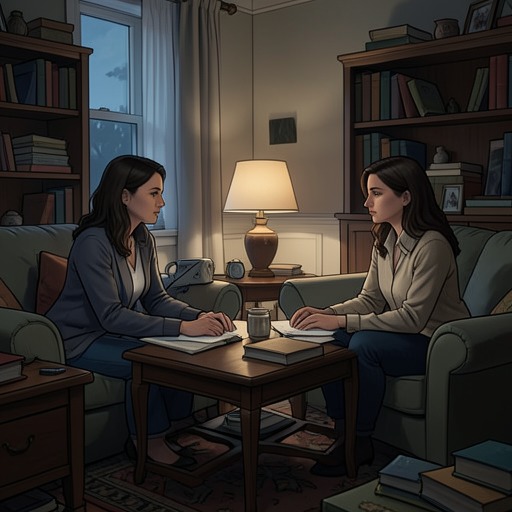
The deeper source of Elizabeth’s survivor guilt emerges in her conversation with Reverend Wakely. She tells him that she had a brother who died by suicide when she was ten. Before that death, she had jumped into a quarry despite being unable to swim. Her brother jumped in after her and somehow got her to the side. The essential imbalance remains stark: she lived because he acted, while he later died and she could not save him.
Reverend Wakely recognizes the connection Elizabeth has made. In his reading, she believes that because her brother rescued her, she ought to have been able to rescue him in return. Elizabeth confirms the painful center of that interpretation by explaining that her brother could not swim either. The detail matters: his rescue of her was not the act of someone untouched by danger or guaranteed to prevail. Yet the memory does not release Elizabeth from her imagined obligation. It makes the debt feel more intimate, because the person who saved her had faced the same peril.
The exchange does not establish that the two deaths were alike. Calvin Evans died in an accident; Elizabeth’s brother died by suicide. Instead, her guilt draws both losses into the same emotional pattern: she survived, and therefore feels answerable for another person’s death. Reverend Wakely cautions that suicide is more complicated than the simple logic of a rescue, and that Elizabeth could not swim when her brother jumped in after her. His response contests the equation without minimizing either the brother’s death or Elizabeth’s grief.
Guilt, Confession, and Acceptance
Elizabeth’s revelations come through speech to other people, but speaking does not make them easy. In telling Roth about Calvin Evans, she moves from the death itself to the vow and to a series of later disappointments. With Reverend Wakely, she reaches further back, to the quarry and her brother’s suicide. The disclosures make visible the connections she has been carrying silently: loss becomes obligation, and obligation becomes a standard by which she judges her later life.
Reverend Wakely tells Elizabeth that she has never forgiven herself, and redirects the work of forgiveness toward her brother. He urges acceptance of what cannot be changed, while acknowledging the limits of answers. That counsel is especially pointed for Elizabeth as a scientist, whose work depends on questioning and searching. He does not suggest that inquiry is useless; rather, he distinguishes unanswered questions from solvable problems. Her brother’s death and Calvin Evans’s death cannot be reversed by finding a better explanation for them.
Elizabeth’s grief also includes an admission of despair. She says that sometimes she understands why her brother left and that, after everything that has happened, sometimes she wants out too. Reverend Wakely answers by distinguishing a wish to escape pain from a wish to return to life. He tells her that she does not truly want out; she wants back in. The distinction does not claim that her suffering has ended. It gives her despair another possible meaning: beneath exhaustion and survivor guilt remains a desire for connection with life.
Significance
Elizabeth’s survivor guilt is not a single reaction to Calvin Evans’s death but a recurring way of interpreting survival and responsibility. The childhood rescue supplies its oldest pattern; Calvin Evans’s death renews it; and the vow never to hold anyone back carries it into her decisions. Her account to Roth shows how readily she gathers professional loss, parenting choices, and unwanted resemblance to her father into the same self-indictment, even while separating Phil Lebensmal’s heart attack from failures she regrets.
The conversations offer no factual undoing of either death and no simple resolution. Instead, they mark a change in how the guilt can be understood. Reverend Wakely identifies the impossible reciprocity Elizabeth has demanded of herself, and his final phrase turns the scene toward participation rather than disappearance. Elizabeth’s movement is therefore not from grief to certainty, but from treating survival as proof of guilt toward the possibility that wanting to live again is itself an answer to loss.